


Blood Tests That See Trouble Coming
High Sensitivity C-reactive Protein (hsCRP) and Fasting Insulin
Your annual physical includes a standard blood panel. Cholesterol, blood sugar, kidney and liver function. These tests catch a lot. But some early warning signs can develop before standard markers pick them up, and that's where these two additional tests may add something useful.
Neither is new or experimental. Most labs can run both. They just rarely come up in routine visits because researchers are still debating how useful they are for everyday screening. Keep one thing in mind as you read. A test only earns its place if knowing the result actually changes what you do.

hsCRP: A Measure of Inflammation in Your Body
When your body is under stress, from an infection, an injury, or strain on your cardiovascular system, your liver releases a protein called C-reactive protein. The high-sensitivity version of this test, hsCRP, measures how much of that protein is in your blood. Higher levels mean more inflammation.
For a long time, doctors focused almost entirely on cholesterol when assessing heart disease risk. Then a major 2008 study called the JUPITER trial found something worth knowing. Nearly 18,000 people with acceptable cholesterol levels but elevated hsCRP were tracked over time. Despite looking fine on standard cholesterol tests, they had significantly higher rates of heart attack and stroke. When treated with a statin, their risk dropped substantially.
What this tells us is that hsCRP can add useful context on top of a standard cholesterol reading, particularly for people whose cholesterol looks borderline. It does not replace cholesterol as a measurement. It can sometimes fill in a gap the standard test can miss.
Most guidelines treat hsCRP as an optional ‘tie-breaker’ in people whose estimated risk falls in the middle range, not clearly low and not clearly high, where the result might help tip a treatment decision.
A reading below 1.0 mg/L is low risk. Between 1.0 and 3.0 mg/L is moderate. Above 3.0 mg/L is high. Above 10 mg/L usually signals something temporary like an infection, and the test should be repeated once that resolves.
One important limitation, hsCRP is nonspecific. Being overweight, smoking, poor sleep, gum disease, and even intense exercise can all raise it temporarily. A high reading tells you inflammation is present somewhere. It does not tell you where. That conversation belongs with your doctor.
Fasting Insulin: An Earlier Look at Diabetes Risk
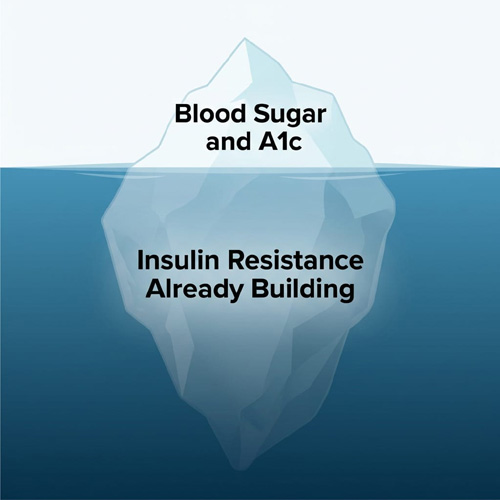
Standard diabetes screening uses fasting glucose and hemoglobin A1c. Both are useful, but they usually reflect problems after insulin resistance has been present for some time. That's one reason people are interested in earlier markers.
Here's why. When your cells start resisting insulin, your pancreas compensates by producing more of it to keep blood sugar normal. So blood sugar and A1c can look fine while your pancreas is quietly working much harder than it should. Measuring fasting insulin can sometimes reveal that pattern earlier, before standard markers have moved.
Observational studies consistently link elevated fasting insulin to higher risk of type 2 diabetes and related health problems, even when blood sugar is still normal. What is less settled is how much elevated insulin itself drives disease versus simply reflecting other underlying problems that would show up through standard testing.
This test is not part of standard screening guidelines, for good reasons. Insulin tests are not consistent across different laboratories, making results hard to track over time. There are also no widely agreed-upon target numbers. Some clinicians, focused on metabolic health, use rough rules of thumb. They look for single-digit values in μIU/mL and treat repeated readings above 10 μIU/mL as worth discussing. These come from clinical experience rather than large trials.
If fasting insulin comes back elevated, the recommended response is the same thing any doctor would suggest based on standard risk factors. Lose excess weight, move more, improve your diet, sleep better. The test rarely opens a new treatment path. What it may do is give you a clearer, earlier reason to act.
If you have a family history of diabetes, carry extra weight around your midsection, or have been told your blood sugar is borderline, it’s reasonable to ask whether your doctor thinks the test would add anything useful.
For many people, these tests wouldn't change what their doctor recommends. They're potential additions for the right person at the right time, not a new checklist for everyone.
If either feels relevant to your situation, bring it up at your next visit. The goal is not more numbers, it's better information that leads to a decision you would not have made otherwise.
Reference Links:
Rosuvastatin to Prevent Vascular Events in Men and Women with Elevated C-Reactive Protein
Paul M Ridker, Eleanor Danielson, Francisco A.H. Fonseca, Jacques Genest, Antonio M. Gotto, Jr., John J.P. Kastelein and Wolfgang Koenig
The New England Journal of Medicine, Published November 20, 2008
Click Here for the Study: https://www.nejm.org/doi/full/10.1056/NEJMoa0807646
2019 ACC/AHA Guideline on the Primary Prevention of Cardiovascular Disease: A Report of the American College of Cardiology/American Heart Association Task Force on Clinical Practice Guidelines
Donna K. Arnett, Roger S. Blumenthal, Michelle A. Albert, Andrew B. Buroker, Esq, Zachary D. Goldberger, Ellen J. Hahn, Cheryl Dennison Himmelfarb, Amit Khera, Donald Lloyd-Jones, J. William McEvoy, Erin D. Michos, Michael D. Miedema, Daniel Muñoz, Sidney C. Smith Jr, Salim S. Virani, Kim A. Williams Sr, Joseph Yeboah and Boback Ziaeian
Circulation, Published 17 March 2019
Click Here for the Study: https://doi.org/10.1161/CIR.0000000000000678
C-reactive protein concentration and risk of coronary heart disease, stroke, and mortality: an individual participant meta-analysis
Stephen Kaptoge, Emanuele Di Angelantonio, Gordon Lowe, Mark B Pepys, Simon G Thompson, Rory Collins, John Danesh
Lancet, Published 2010 Jan 9
Click Here for the Study: https://doi.org/10.1016/s0140-6736(09)61717-7
Hyperinsulinemia as an Independent Risk Factor for Ischemic Heart Disease
Jean-Pierre Després, Benoît Lamarche, Pascale Mauriège, Bernard Cantin, Gilles R. Dagenais, Sital Moorjani and Paul-J. Lupien
The New England Journal of Medicine, Published April 11, 1996
Click Here for the Study: https://www.nejm.org/doi/full/10.1056/nejm199604113341504
Fasting and 2-Hour Plasma Glucose and Insulin: Relationship with risk factors for cardiovascular disease in overweight nondiabetic children
Ingrid M. Libman, Emma Barinas-Mitchell, Andrea Bartucci, Diego Chaves-Gnecco, Robert Robertson, Silva Arslanian
Diabetes Care, Published December 01 2010
Click Here for the Study: https://doi.org/10.2337/dc10-0085
Insulin Resistance/Hyperinsulinemia as an Independent Risk Factor That Has Been Overlooked for Too Long
Serafino Fazio, Flora Affuso, Arturo Cesaro, Loredana Tibullo, Valeria Fazio and Paolo Calabrò
biomedicines, Published 26 June 2024
Click Here for the Study: https://doi.org/10.3390/biomedicines12071417
Call for a FREE Consultation (305) 296-3434
CAUTION: Check with your doctor before
beginning any diet or exercise program.
5/21/2026


