


In Defense of "Banned" Exercises
When Good Exercises Get Bad Press
Last week, I looked at exercises with poor risk-to-reward ratios for most people. This week, let's flip the script and talk about exercises that get unfairly demonized, plus two movements that need clarification rather than elimination.
The theme here is nuance. Some exercises aren't dangerous. They just require attention to details. Others have been wrongly blacklisted based on outdated thinking or misunderstood research. Here are two exercises that need clarification.
Leg Press: It's about spinal position, not knee depth.
The Problem: When you bring your knees very close to your chest, your pelvis tilts backward and your lower back rounds under load. This creates compression forces on your spine.
What does the research show? The problem isn't knee depth alone but the combination of hip position, pelvic tilt, and spinal flexion while pushing heavy weight. This matters most for people with existing back issues.
How to do it right: Stop before your pelvis tilts backward. Watch for when your lower back starts to round. That's your limit. For many people, this happens when thighs approach the torso at roughly 90 degrees.
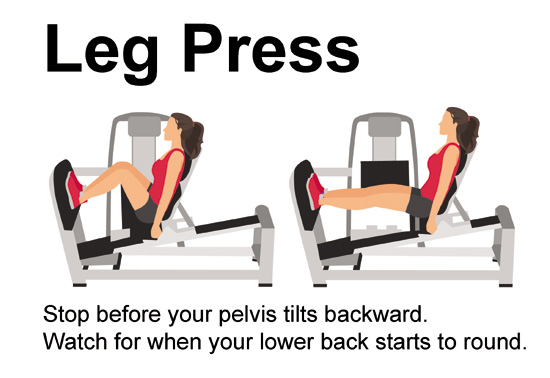
The difference from squats: Deep squats are fine because your pelvis and spine move freely. The leg press fixes your torso in place, which encourages pelvic tuck and lumbar flexion. If you can maintain a neutral spine throughout, the risk is lower. But most people can't.
Sit-Ups: The research is real, but context matters.
The Problem: Traditional sit-ups with feet held down generate high compression forces on your spine while repeatedly flexing it under load.
What does the research show? Spine researcher Dr. Stuart McGill's work shows sit-ups can generate lumbar compression forces around 3,400 Newtons, exceeding the 3,300 N threshold that occupational safety guidelines use as a limit. His research also demonstrates that repeated spinal flexion under compression increases disc herniation risk.
Some military organizations have reduced or eliminated sit-ups from fitness testing due to test-related injuries.
What works better? Planks, dead bugs, bird dogs, and Pallof presses challenge your core to resist movement rather than create it. These build strength while minimizing spinal compression.
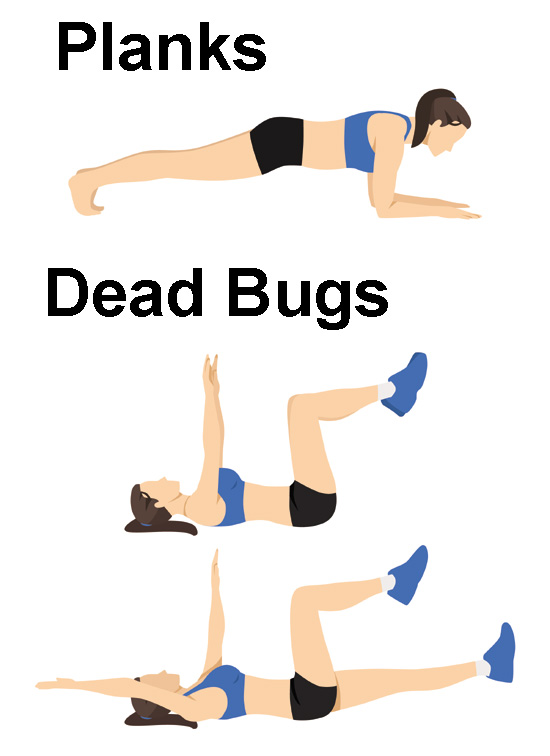
Who might be different? Sit-ups aren't acutely dangerous for healthy people doing them occasionally. Some athletes in sports requiring spinal flexion need to train that pattern. But for general fitness, alternatives exist that build the same strength with less stress.
These are some exercises that deserve rehabilitation.
Leg Extensions
The claim: Leg extensions are only for rehabilitation and create dangerous knee shear forces.
The reality: Recent research shows leg extensions produce meaningful quadriceps growth comparable to squats. They're valuable for people who can't load their spine heavily or those wanting to add quad volume without systemic fatigue.
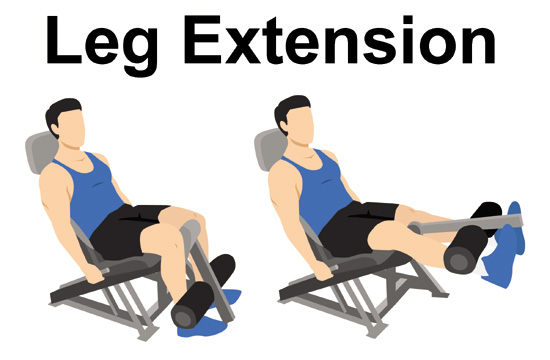
The "dangerous shear force" claim comes from misunderstood biomechanics. For healthy knees, leg extensions aren't problematic.
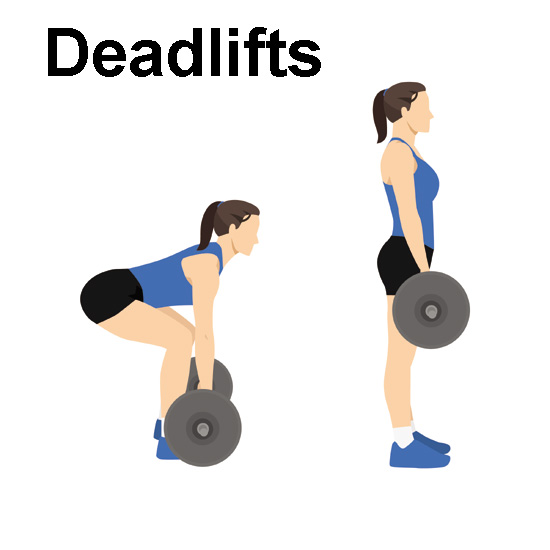
Conventional Deadlifts
The claim: Deadlifts are too dangerous for most people.
The reality: The problem isn't the exercise. It's improper technique. Deadlifts remain one of the most effective movements for posterior chain strength and functional lifting capacity. The solution is learning proper form: neutral spine, hip hinge pattern, lat engagement, and appropriate load progression.
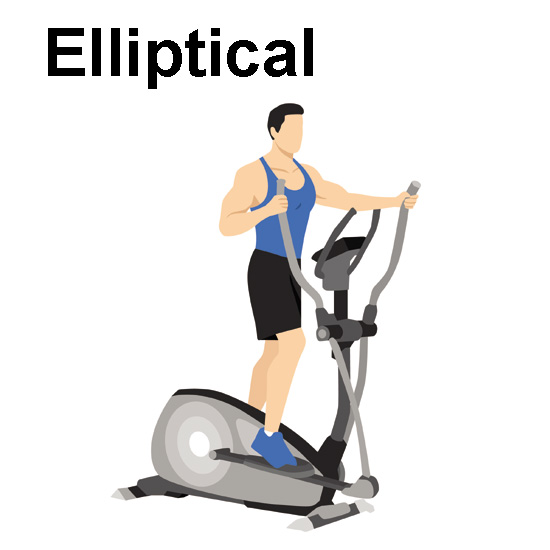
Elliptical Machines
The claim: Ellipticals are a waste of time.
The reality: They're not optimal for bone density or serious cardiovascular development, but they serve a legitimate purpose for people needing low-impact cardio. Those with joint pain, people returning from injury, or individuals who need cardiovascular conditioning without impact stress. Not everyone can or should run.
This is what everyone needs to understand. Exercise selection isn't about creating banned lists. It's about acknowledging your body's current capabilities, the specific demands each exercise places on your joints, whether alternatives exist that serve your goals with less stress, and the quality of instruction available to you.
Some exercises need modification. Some need proper coaching. Some are fine but limited. And some have been unfairly blacklisted based on outdated information.
The goal isn't to create fear around movement. It's to make informed choices that match your individual context.
Train smart. Move well. Choose variations that work for your body.
Part 1 2
Reference Links:
A Comparison of Free Weight Squat to Smith Machine Squat Using Electromyography
Schwanbeck, Shane; Chilibeck, Philip D; Binsted, Gordon
The Journal of Strength and Conditioning Research, Published December 2009
Click Here for the Study: https://doi.org/10.1519/jsc.0b013e3181b1b181
The Upright Row: Implications for Preventing Subacromial Impingement
Brad J Schoenfeld, Morey J Kolber, Jonathan E Haimes
Strength and Conditioning Journal, Published October 2011
Click Here for the Study: https://doi.org/10.1519/SSC.0b013e31822ec3e3
Characteristics of Shoulder Impingement in the Recreational Weight-Training Population
Kolber, Morey; Cheatham, Scott; Salamh, Paul; Hanney, William J.
The Journal of Strength and Conditioning Research, Published April 2014
Click Here for the Study: https://doi.org/10.1519/jsc.0000000000000250
Upper Extremity Weight-Training Modifications for the Injured Athlete
Martin Fees, Tony Decker, Lynn Snyder-Mackler, and Michael J. Axe
American Orthopoedic Society for Sports Medicine, Published September 1998
Click Here for the Study: https://doi.org/10.1177/03635465980260052301
Shoulder impingement: Biomechanical considerations in rehabilitation
Paula M. Ludewig, Jonathan P. Braman
Manual Therapy, Published Volume 16, Issue 1, February 2011, Pages 33-39
Click Here for the Study: https://doi.org/10.1016/j.math.2010.08.004
Overhead shoulder press – In-front of the head or behind the head?
Mark R. McKean, Brendan J. Burkett
Journal of Sport and Health Science, Published Volume 4, Issue 3, September 2015, Pages 250-257
Click Here for the Study: https://doi.org/10.1016/j.jshs.2013.11.007
Call for a FREE Consultation (305) 296-3434
CAUTION: Check with your doctor before
beginning any diet or exercise program.
1/28/2026


