


The Truth About “Bad” Exercises
Should You Actually Avoid These Three Exercises?
After two decades of writing about fitness, I've seen countless “never do these exercises” articles. Most oversimplify, some create unnecessary fear, and only a few get it right.
Very few exercises are dangerous for everyone. But some put extra stress on your joints without giving most people better results. When safer options exist that work the same muscles, why not use those?
When I talk about “risk,” I mean movements that put your joints in awkward positions, not exercises that will definitely hurt you. The research shows which movements are harder on your joints, not which cause injuries for sure.
Behind-the-Neck Press and Pulldowns
The Problem: When you press or pull a weight behind your head, your arms twist into an extreme position. Your elbows point out to the sides while your hands rotate outward. This squeezes the space in your shoulder where important tendons live.
What does the research show? These conclusions are based on biomechanical models and clinical observations rather than injury trials. Studies show this position makes the space inside your shoulder smaller, which can pinch the tendons. Shoulder doctors and physical therapists may see this as riskier, especially if you have stiff shoulders or a history of shoulder problems.
What works better? Regular overhead presses and pulldowns, where you bring the bar in front work the same muscles while keeping your shoulders more comfortable. Studies measuring muscle activity show results similar to those with front versions, so for most people, there's little benefit from the extra joint stress.
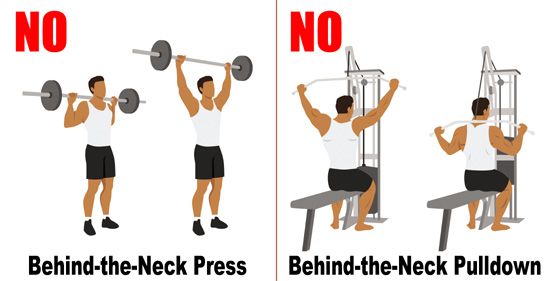
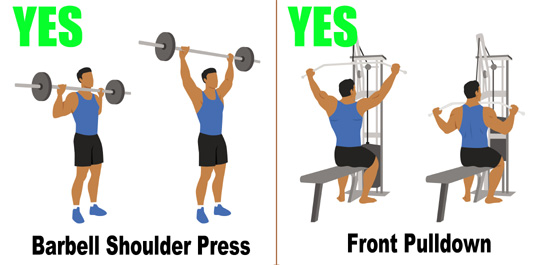
Who might be different? If your shoulders are very flexible, you have no pain, and a specific reason to do these (like Olympic weightlifting training), you can include them. Otherwise, stick with front versions.
Cable Upright Rows Pulled High With a Narrow Grip
The Problem: When you pull a bar to your chest or chin with hands close together, your shoulders twist inward while your arms lift high. This compresses the space inside your shoulder.
What does the research show? Like behind-the-neck movements, this comes from biomechanical models rather than injury trials. Experts found that twisting your shoulders inward while raising your arms above shoulder height can squeeze shoulder space, creating conditions that can irritate the joint, especially with existing shoulder issues.
What works better? Lateral raises, face pulls, or wide-grip rows work your shoulders and upper back without putting you in an awkward position, leaving more room inside the joint.
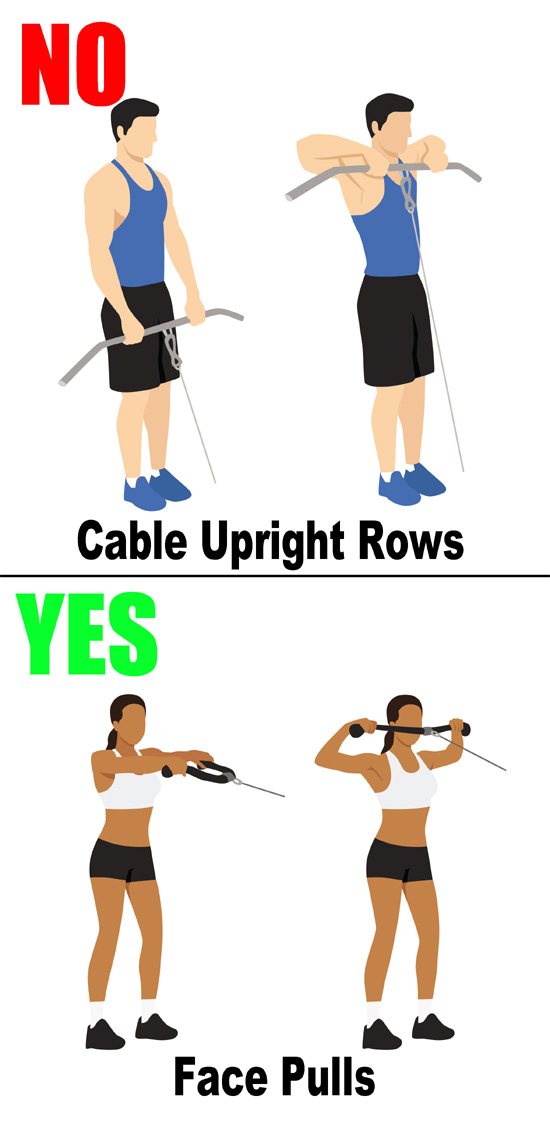
Who might be different? Stopping the pull at mid-chest with a wider grip reduces the problem. But if you're getting the same muscle development from exercises that feel better, why use the harder option?
Smith Machine Squats (for Most People)
The Problem: The Smith machine forces the bar to move straight up and down on a track. Your body has to move around that fixed path instead of moving naturally. Everyone squats differently based on their body proportions and flexibility.
What does the research show? A 2009 study in the Journal of Strength and Conditioning Research found greater muscle activity during regular squats than during Smith machine squats. Your stabilizing muscles work harder with free weights.
More muscle activity doesn't automatically mean better results, but it does mean your body works differently. This suggests regular squats may be better for building overall strength and practicing movements you use in real life.
The issue here is opportunity cost, not injury risk. The Smith machine is usually less effective than free squats for building strength and natural movement patterns.
What works better? Regular barbell squats, goblet squats, or safety bar squats let your body move naturally. If you can't load your back, try leg presses or belt squats.
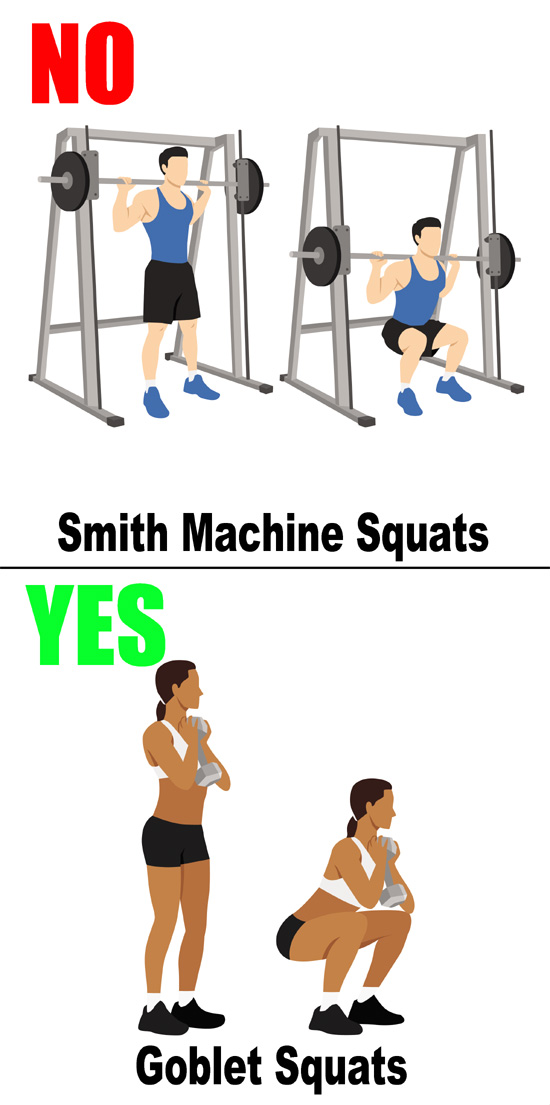
Who might be different? The Smith machine is helpful for specific rehab or for people with severe balance problems. Some bodybuilders use it to target specific muscles. But most people get better results with regular squats.
Choosing exercises is about understanding trade-offs. The exercises above aren't forbidden and are appropriate in certain situations. But for most people, most of the time, other options work the same muscles while being easier on your joints.
Exercises don't hurt people on their own. Using the wrong movement, with the wrong load, for the wrong body causes most problems.
Part 1 2
Reference Links:
A Comparison of Free Weight Squat to Smith Machine Squat Using Electromyography
Schwanbeck, Shane; Chilibeck, Philip D; Binsted, Gordon
The Journal of Strength and Conditioning Research, Published December 2009
Click Here for the Study: https://doi.org/10.1519/jsc.0b013e3181b1b181
The Upright Row: Implications for Preventing Subacromial Impingement
Brad J Schoenfeld, Morey J Kolber, Jonathan E Haimes
Strength and Conditioning Journal, Published October 2011
Click Here for the Study: https://doi.org/10.1519/SSC.0b013e31822ec3e3
Characteristics of Shoulder Impingement in the Recreational Weight-Training Population
Kolber, Morey; Cheatham, Scott; Salamh, Paul; Hanney, William J.
The Journal of Strength and Conditioning Research, Published April 2014
Click Here for the Study: https://doi.org/10.1519/jsc.0000000000000250
Upper Extremity Weight-Training Modifications for the Injured Athlete
Martin Fees, Tony Decker, Lynn Snyder-Mackler, and Michael J. Axe
American Orthopoedic Society for Sports Medicine, Published September 1998
Click Here for the Study: https://doi.org/10.1177/03635465980260052301
Shoulder impingement: Biomechanical considerations in rehabilitation
Paula M. Ludewig, Jonathan P. Braman
Manual Therapy, Published Volume 16, Issue 1, February 2011, Pages 33-39
Click Here for the Study: https://doi.org/10.1016/j.math.2010.08.004
Overhead shoulder press – In-front of the head or behind the head?
Mark R. McKean, Brendan J. Burkett
Journal of Sport and Health Science, Published Volume 4, Issue 3, September 2015, Pages 250-257
Click Here for the Study: https://doi.org/10.1016/j.jshs.2013.11.007
Call for a FREE Consultation (305) 296-3434
CAUTION: Check with your doctor before
beginning any diet or exercise program.
1/28/2026


