


The Top Five Abdominal Exercises
Strong abdominal muscles are vital for maintaining good posture, preventing back pain, and improving overall athletic performance. However, not all ab exercises are equally effective. Some common exercises, such as sit-ups and traditional crunches, can strain the lower back and neck unnecessarily.
A team led by Peter Francis, Ph.D., and Jennifer Davis, M.A., in SDSU’s Biomechanics Lab, decided to find the best exercises to activate your abdominal muscles. These are the top five, with detailed instructions on how to perform each one.
Bicycle Crunch:
Bicycle crunches are a variation on the classic crunch exercise that involves alternating opposite elbow to opposite knee movements.
1. Lay down face up on a mat and place the fingertips behind the ears. Bend your knees at a 90-degree angle. Keep your heels and shoulders slightly off the ground.
2. Engage your core muscles, exhale and lift your shoulders and upper back up, bringing your right elbow towards your left knee.
3. Inhale while extending the spine and straightening the left leg.
4. Switch sides, bringing your left elbow towards your right knee, and continue to alternate for several reps.
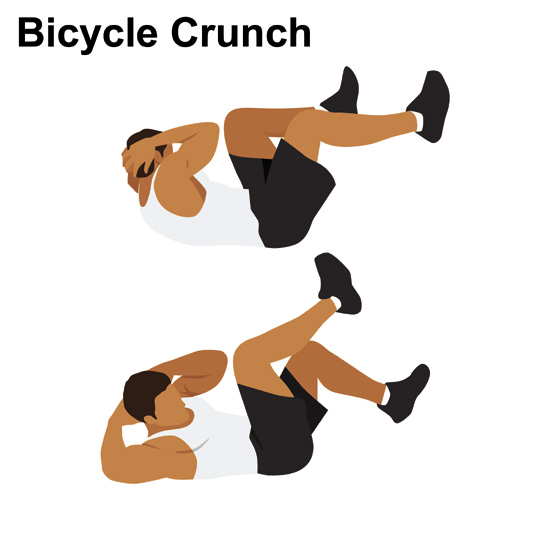

Key Points: Move in a controlled motion. Bring both shoulder blades off the mat with each rep. Extend the straight leg completely with each rep bringing it as close to the floor as possible to engage the obliques and lower abdominals. If the lower back fatigues, re-emphasize core activation on each rep.
Common Cheats: Do not roll from one side to the other. Do not allow the heels to touch the floor. Do not place fingers behind the head, just the ears. Do not attempt to touch the elbow to the knee; instead, focus on bringing the rib to the hip.
Captains Chair:
To do this exercise, you will need a captain’s chair or similar equipment with armrests and back support. You can do an advanced version of the exercise while hanging from an overhead bar.
1. Stand in front of the captain’s chair and grip the armrests with your hands.
2. Lift yourself off the ground and use your arms to support your weight.
3. Engage your core muscles and raise your legs straight out in front of you, so they are parallel to the ground.
4. If you cannot keep your legs straight out, you can work up to it. Start by raising your legs and keeping them bent, as shown in the illustration.
5. Hold this position for a moment, then slowly lower your legs back down to the starting position and repeat.
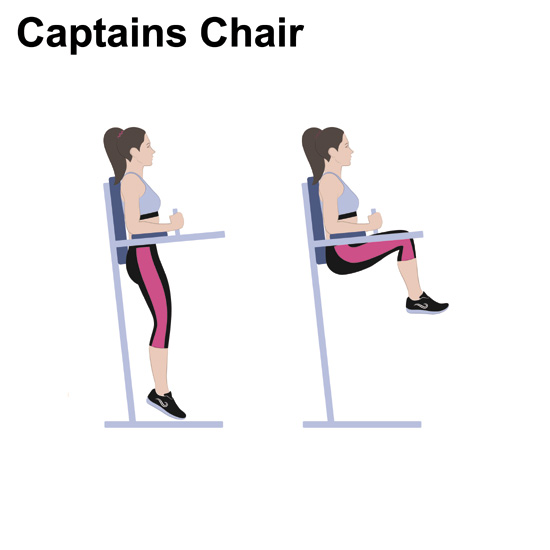

Key Points: It’s essential to keep your core engaged and your body straight throughout the exercise to maximize the benefits and avoid straining your back. Use a controlled descent to keep continuous tension on the abdominals and hip flexors. As you get stronger, you can increase the difficulty of the exercise by holding a weight or a medicine ball between your feet.
Common Cheats: Do not break tension on the abdominals or hip flexors between reps. Do not swing or jerk the legs. Do not lock the knees.
Stability Ball Crunch:
You will need a stability ball and a flat surface to do this exercise.
1. Sit on the stability ball with your feet flat on the ground and slightly wider than your shoulders. Put your fingertips behind your ears.
2. Walk your feet forward until your lower back rests on the ball and your knees are bent at a 90-degree angle.
3. Engage your core muscles, lift your upper body off the ball, and exhale, bringing your shoulders and head up towards your knees.
4. Hold this position for a moment, then inhale and slowly lower your upper body to the starting position. Repeat.
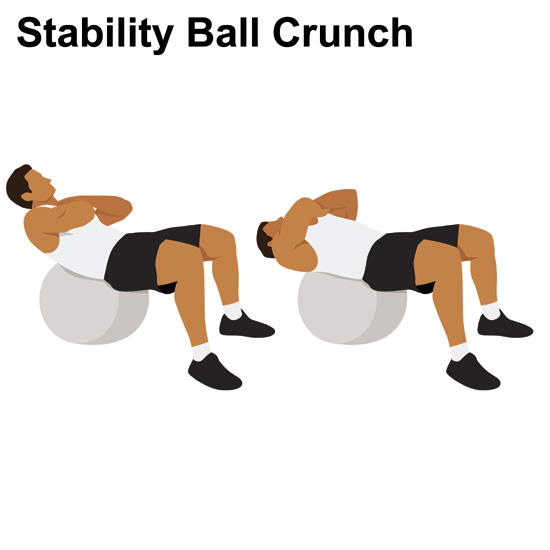
Key Points: To determine the appropriate ball size, when in position (Step 2), the hips should be level with or below the knees. If the hips are higher than the knees, use a smaller ball. Keep the neck in a neutral position throughout the exercise. The sacrum (lower part of your spine just above the tailbone) should remain pressed against the ball. The ball should remain stationary during the entire exercise. If the lower back hurts during this exercise, the transversus abdominis is likely not engaged. Re-examine core activation to correct this.
Common Cheats: Do not let the shoulders touch the ball or wrap the spine around the ball. Do not drop the hips, jerk the back, or move the knee joint when crunching.
Variations: To decrease difficulty, cross your arms over your chest, making a fist with each hand and place fists under the chin. You can also use a large ball to make it easier. To increase difficulty, put feet closer together.
Vertical Leg Crunch:
To do this exercise, you will need a flat surface and a mat or cushion to protect your lower back.
1. Lie on your back on the floor with your knees bent and your fingertips behind your ears.
2. Extend your legs straight up in the air, crossed at the ankles with a slight bend in the knee.
3. Lift your head, shoulders, and upper back off the ground and bring your torso to your knees.
4. Hold this position for a moment, then slowly lower your upper body back down to the starting position.
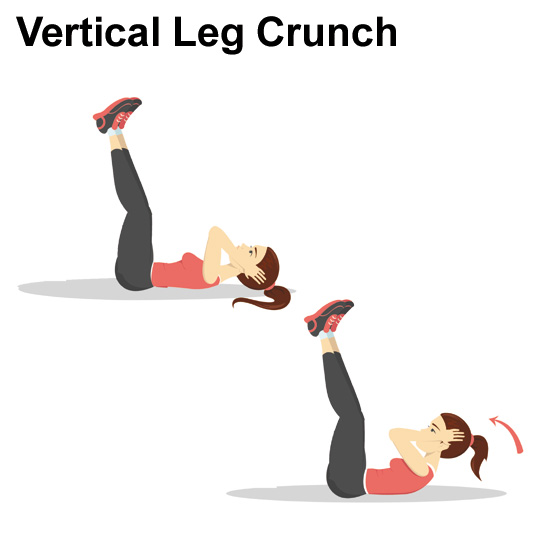
Key Points: Keep your core engaged throughout the exercise to maximize the benefits. Avoid pulling on your neck or head with your hands. Use your abs to lift your upper body instead. Keep your lower back pressed firmly against the floor to avoid straining your back. You may need a cushion or mat under your lower back for added support if you have lower back pain.
Common Cheats: Using momentum to lift your upper body, pulling on your neck with your hands, and letting your lower back lift off the floor.
Reverse Crunch:
To do this exercise, you will need a flat surface and a mat or cushion to protect your lower back.
1. Lie on your back on the floor with your lower back pressed to the ground.
2. Put your fingertips behind your ears or extend your arms out flat to your sides, whichever feels more comfortable.
3. Cross your feet at the ankles, then lift your feet off the ground until your knees create a 90-degree angle. This is the starting position.
4. Press your lower back into the floor and exhale as you contract your abdominal muscles. With each contraction, your hips will rotate slightly, and your legs will reach toward the ceiling.
5. Inhale and return to the starting position.
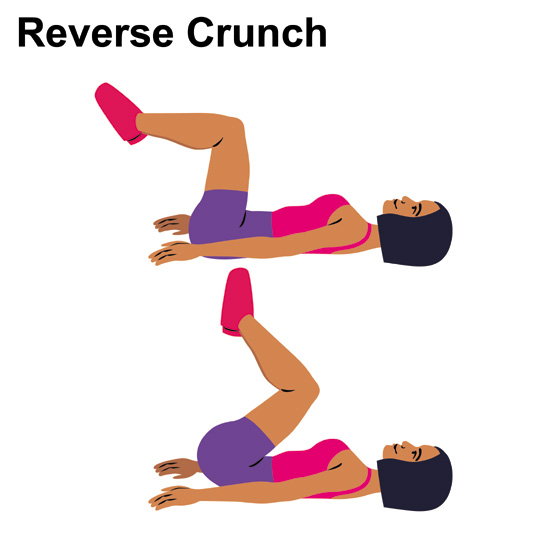
Key Points: Keep your core engaged throughout the exercise to maximize the benefits. Avoid pulling on your neck or head with your hands.
Common Cheats: Using momentum to rock back and forth quickly and pulling on your neck with your hands.
Reference Links:
New Study Puts the Crunch on Ineffective Ab Exercises
Click Here for the Information from ACE
Call for a FREE Consultation (305) 296-3434
CAUTION: Check with your doctor before
beginning any diet or exercise program.
12/15/2022
-
 Six Exercises for Better Form - Part 1 - One Leg Romanian Dead Lift, Push-Ups & Inverted Row
 -
 Muscle Confusion - Are Random Workouts Better than a Planned Program?
 -
 Five Ways to Improve Your Form Working Out Alone
Can you isolate your upper and lower abs? According to this study, probably not. Dr. Francis found that the average exerciser could not target upper or lower abdominal exercises independently. It appears that the upper and lower rectus abdominus act as one large muscle group.