


Five Things to Check That May Reveal Your Stroke Risk
Blood Pressure, Heart Rhythm, Walking Speed, Waistline and Grip Strength
A stroke can strike in seconds. But the conditions behind it usually take years to build, and many of them can be measured.
INTERSTROKE, a study of nearly 27,000 people in 32 countries, estimated that about 90% of stroke risk is tied to factors that can potentially be changed. No guarantees, but you have more control than you think.
Here are five checks worth doing. The first two can uncover medical conditions with proven treatments. The last three are health markers that research links to stroke risk.
1. Your Blood Pressure
If you check only one thing, make it this. In INTERSTROKE, high blood pressure nearly tripled the odds of a stroke. It was tied to almost half of all strokes, more than any other risk factor.
High blood pressure usually has no symptoms, so the only way to find out is to measure it. Use an automatic upper-arm monitor with the right size cuff. Rest quietly for five minutes, sit with your back supported and your arm at heart level, and check over several days. One reading doesn't tell the whole story.
Bringing it down pays off. A review of 123 studies with more than 600,000 people found that every 10-point drop in the top number lowered the relative risk of stroke by about 27%. The American Heart Association counts readings that average 130 or higher on top, or 80 or higher on the bottom, as high blood pressure. If yours land there, talk with your doctor.

2. Your Heart Rhythm
Put two fingers on your wrist. Is your pulse steady like a metronome, or does it skip and stumble? An irregular pulse can signal atrial fibrillation, or AFib. The heart's upper chambers quiver instead of squeezing, blood can pool, and clots can form and travel to the brain.
According to the American Heart Association, AFib makes a stroke up to five times more likely, even when you feel perfectly fine. So an irregular pulse deserves a checkup, but a steady one isn't a free pass. A heart rhythm test, like an EKG, is how doctors confirm AFib.
Treatment works. In clinical trials, the anticoagulant warfarin lowered stroke risk by about 64% compared with no blood-thinning treatment. Aspirin isn't a substitute. Not everyone with AFib needs an anticoagulant, so your doctor will weigh your stroke risk against your bleeding risk.

3. Your Walking Speed
How would you describe your usual walking pace? Slow, steady or brisk?
That simple question told researchers a lot. In a 2026 study of nearly 483,000 UK adults, people who called themselves slow walkers had a 64% higher stroke risk than those who called themselves brisk walkers. Genetic data from the study hint that pace itself may matter, though the study didn't test whether deliberately walking faster prevents strokes.
Staying active matters too. In INTERSTROKE, active people had about 40% lower odds of stroke. Aim for walks that leave you a little breathless but still able to talk.

4. Your Waistline
In INTERSTROKE, people with the highest waist-to-hip ratios had 44% higher odds of stroke than people with the lowest.
A simple check uses your height instead of your hips. Cut a piece of string as long as you are tall. Fold it in half, then wrap that doubled-over length around your waist, keeping it snug without pulling it tight.
If the ends overlap, your waist is less than half your height. That's a good sign. If they just meet, you're right at the recommended limit. If they don't reach, your waist is more than half your height, and that may be a warning sign of increased health risk.

5. Your Grip Strength
Your handshake may say more about your health than you think. The same 2026 study linked weaker grip to higher stroke risk. In a European study of nearly 25,000 adults 50 and older, people with a weak grip had a 55% higher risk.
Using a handgrip dynamometer, a device you squeeze as hard as you can, researchers called grip weak below about 60 pounds of force for men and 35 pounds for women. Those are cutoffs for muscle weakness, not stroke risk. Some clinics and fitness facilities can test you.
Think of grip as a gauge of your overall strength rather than a target in itself. These studies don't show that strengthening your grip prevents strokes, but that's no reason to skip strength training. It keeps your muscles strong and your body working well as you age.

The Bottom Line
These checks can't predict a stroke, and they aren't the whole picture, since smoking, diabetes, diet and stress matter too. But each one can point you toward something worth doing. So this week, check your blood pressure, feel your pulse, think about your pace, measure your waist and ask about a grip test.
One last thing. These are long-term risk factors, not signs of a stroke in progress.
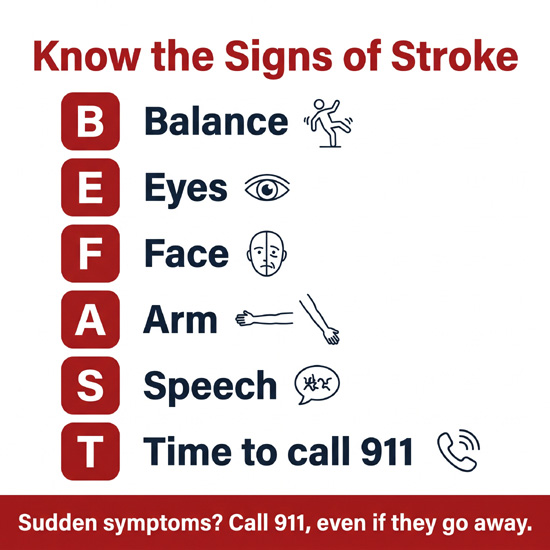
If you or someone near you suddenly loses balance, has vision changes, develops a drooping face or arm weakness, or has trouble speaking, call 911 immediately, even if the symptoms go away. Remember BE FAST: Balance, Eyes, Face, Arm, Speech, Time to call 911.
Reference Links:
Global and regional effects of potentially modifiable risk factors associated with acute stroke in 32 countries (INTERSTROKE): a case-control study
Dr Martin J O'Donnell, Siu Lim China, Sumathy Rangarajan, Prof Denis Xavier, Prof Lisheng Liu, Prof Hongye Zhang, Purnima Rao-Melacini, Xiaohe Zhang, Prof Prem Pais, Steven Agapay, Prof Patricio Lopez-Jaramillo, Albertino Damasceno, Prof Peter Langhorne, Prof Matthew J McQueen, Prof Annika Rosengren, Mahshid Dehghan, Prof Graeme J Hankey, Prof Antonio L Dans, Prof Ahmed Elsayed, Prof Alvaro Avezum, Prof Charles Mondo, Prof Hans-Christoph Diener, Prof Danuta Ryglewicz, Prof Anna Czlonkowska, Prof Nana Pogosova, Prof Christian Weimar, Romaina Iqbal, Prof Rafael Diaz, Prof Khalid Yusoff, Prof Afzalhussein Yusufali, Prof Aytekin Oguz, Prof Xingyu Wang, Ernesto Penaherrera, Prof Fernando Lanas, Okechukwu S Ogah, Prof Adesola Ogunniyi, Helle K Iversen, Prof German Malaga, Prof Zvonko Rumboldt, Prof Shahram Oveisgharan, Fawaz Al Hussain, Daliwonga Magazi, Yongchai Nilanont, John Ferguson, Guillaume Pare, Prof Salim Yusuf, DPhila on behalf of the INTERSTROKE investigators
The Lancet, Published August 20, 2016
Click Here for the Study: http://dx.doi.org/10.1016/S0140-6736(16)30506-2
Blood pressure lowering for prevention of cardiovascular disease and death: a systematic review and meta-analysis
Dena Ettehad, MSca ∙ Connor A Emdin, HBSca ∙ Amit Kiran, PhDa ∙ Simon G Anderson, PhDa,c ∙ Thomas Callender, MB ChBa,d ∙ Jonathan Emberson, PhDb ∙ Prof John Chalmers, PhDe ∙ Prof Anthony Rodgers, PhDe ∙ Prof Kazem Rahimi, DM FRCPa
The Lancet, Published March 05, 2016
Click Here for the Study: https://doi.org/10.1016/S0140-6736(15)01225-8
Meta-analysis: Antithrombotic Therapy to Prevent Stroke in Patients Who Have Nonvalvular Atrial Fibrillation
Robert G. Hart, MD, Lesly A. Pearce, MS, and Maria I. Aguilar, MD
Annals of Internal Medicine, Published 19 June 2007
Click Here for the Study: https://doi.org/10.7326/0003-4819-146-12-200706190-00007
Sarcopenia, Grip Strength, Walking Pace, and New-Onset Stroke Risk: A UK Biobank Study
Li-Li Tang, MMed, Yu-Hui Huang, PhD, Yu-Jia Jin, MD, Kai-Cheng Yang, MMed, Qing Lin, MD, Zien Zhou, PhD, Feng Gao, MD, Bing Xiong, MD, Changzheng Yuan, ScD, and Lu-Sha Tong, MD
STROKE, Published 8 May 2026
Click Here for the Study: https://doi.org/10.1161/STROKEAHA.125.052311
Associations of Handgrip Strength Weakness and Asymmetry With New-Onset Stroke in Middle-Aged and Older Adults: A Prospective Cohort Study in Europe
Pincheng Luo, Yanxue Lian
Geriatrics & Gerontology International, Published 28 June 2026
Click Here for the Study: https://doi.org/10.1111/ggi.70622
Call for a FREE Consultation (305) 296-3434
CAUTION: Check with your doctor before
beginning any diet or exercise program.
7/13/2026
Updated 11/11/2026


