


Ancient Wisdom for Modern Fitness
6 Stoic Lessons for a Healthier Life
Ask people what they want from their health, and you'll usually get a list. Lose twenty pounds. Fit into the old jeans. Run a 5K. Those are good goals. But they aren't the whole point.
The Stoic philosophers of ancient Greece and Rome thought hard about what makes a life go well. They considered health worth preferring and pursuing, but not something that determined whether a person lived a good life. That depended on character, choices, and how you handled whatever came your way. Two thousand years later, their ideas apply to fitness surprisingly well.
1. Question your thoughts before you believe them.
"I already blew my diet today, so why bother?" "I'll never be in shape." Thoughts like these feel like facts because they show up in your own head. Epictetus, a former slave who became one of Rome's great teachers, said people are disturbed not by things, but by their judgments about things.
He told his students to treat a troubling thought as just an impression and examine it before accepting it. Is it accurate, or am I turning one hard day into a prediction about my whole future? Then ask whether there's a helpful next step. If there is, take it. If not, you don't have to keep arguing with the thought.
2. Focus on what's up to you.
One of Epictetus's central lessons is knowing what's up to you and what isn't. You don't choose your genes or stop the passage of time. Your habits can influence your weight and fitness, but they can't dictate every result. Other people's opinions aren't up to you either, like the relative who's hurt when you pass on seconds. What is up to you is the choice you make with what you have, and how you respond. Put your energy there.
3. You become what you repeatedly do.
Epictetus taught that every habit grows stronger with practice. If you want to be a good reader, read. If you want to be a writer, write. Intentions cost nothing. Actions build who you are.
In a University College London study, Phillippa Lally and colleagues found that daily behaviors became more automatic over time, but the pace varied widely. There's no magic number. Some people needed a few weeks, and others needed many months.
It helps to tie a new habit to a regular cue, like a short walk after lunch, rather than a vague promise to exercise more. Then it's a matter of ordinary Tuesdays, each one reinforcing the habit.
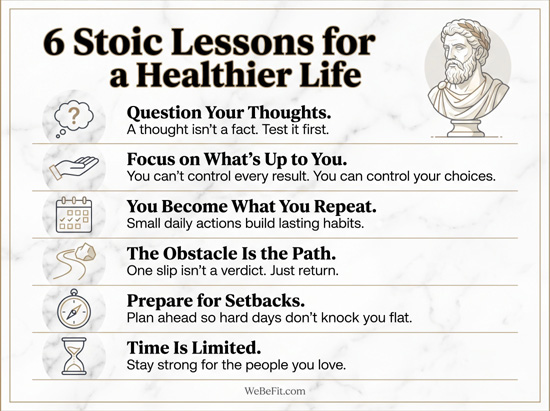
4. The obstacle is part of the path.
Marcus Aurelius, the Roman emperor whose private reflections became the Meditations, wrote that "the impediment to action advances action. What stands in the way becomes the way." A missed workout or a disrupted routine doesn't have to end your efforts. It's a chance to practice adapting.
That same University College London study found that missing a day here and there didn't stop people from building a habit. One slip isn't a verdict. The useful question is what you can get back to next.
5. Prepare for setbacks before they arrive.
The Stoics knew health can't be guaranteed, no matter how well you care for yourself. Seneca, a Roman statesman and philosopher, recommended picturing hardships in advance so they don't knock you flat.
Think ahead to the injury, the busy month, or the slow week that could throw you off course. Planning won't make every setback easy. But it can make the next decision clearer, whether that's shortening a workout, changing the activity, or getting help.
6. Remember that time is limited.
Epictetus gave his students advice that sounds harsh. When you kiss your child, he said, remember that you're kissing someone mortal, so that if loss comes, it won't overwhelm you. For modern readers, his words can also be a reminder not to take our time with loved ones for granted.
That may be the best reason of all to take care of yourself. It's about having the strength and energy to play with your grandkids, travel with your partner, and be there for the people who need you, for as long as you're given.
The Stoics believed a good life depended not on controlling everything around you, but on your character, your choices, and how you respond to what happens. Health was worth pursuing, but never guaranteed. Fitness works the same way. You can't control every bad day. You can choose what you do next.
Start with one lesson. Pick the one that stung a little when you read it. That's probably the one you need most.
Reference Link:
How are habits formed: Modelling habit formation in the real world
Phillippa Lally, Cornelia H. M. van Jaarsveld, Henry W. W. Potts, Jane Wardle
European Journal of Social Psychology, Published 16 July 2009
Click Here for the Study: https://doi.org/10.1002/ejsp.674
Call for a FREE Consultation (305) 296-3434
CAUTION: Check with your doctor before
beginning any diet or exercise program.
10/22/2026


