


Cardio Won't Build the Body You Want
The Treadmill Trap
Most people who want to lose fat do the same thing. They turn to cardio. More treadmill, more time on the bike, more sweat on the floor. I see it constantly.
Five or six days a week on the treadmill. They're proud of the miles and proud of the sweat, and they should be, because it isn't easy. But six months later they look in the mirror and see almost the same person. A little smaller, maybe. Softer though, not firmer. Tired instead of strong.
Then the frustration hits. "I'm doing everything right. Why isn't it working?" So they add even more cardio, which is like digging faster when you're already in the wrong hole.
Here's what I've had to tell a lot of people over the years. They didn't fail, their plan did. They trained to get tired, but they never gave their muscles a reason to grow. And muscle, not miles, is what changes how your body looks and works.
Here's why muscle should be your real goal.
When people say they want to "tone up," what they want is muscle. Muscle gives your body its shape and makes your waist look tighter. But it does much more than look good. Muscle is where your body stores blood sugar, so more of it helps you handle sugar better. It keeps your bones strong and helps you carry groceries, climb stairs, and get up off the floor without help. As you get older, keeping your muscle is one of the best ways to stay strong and independent.
There are three parts.
Part 1: Make your muscles work hard. You don't have to lift the heaviest weight in the gym. What matters is pushing close to the point where you couldn't do another rep. That's the signal that tells your body, "Keep this muscle and make it stronger." Fast, light, "feel the burn" sets leave you sweaty and worn out, but sweat isn't growth. And the weight has to slowly get harder over time. A little more, a little more, week after week. That slow climb builds a stronger body.
Part 2: You grow while you rest. You don't get stronger while lifting. You get stronger while recovering afterward. Think of building a house. Lifting delivers the lumber, but the building happens later, while you recover. Never recovering is like hauling the lumber away every afternoon before anyone can build. Sleep is a big part of this, and no workout makes up for weeks of bad sleep. When you're always run-down, you move less, sleep worse, and train weaker the next time.
Part 3: You have to eat to grow. Your body only builds muscle if it believes it can afford to. That means enough food, and especially enough protein, the building block muscle is made from. Most people need more than they think.
The opposite mistake is cutting food down to almost nothing and wondering why nothing improves. A hungry, worn-out body doesn't hand you muscle. It hangs on for dear life. If you're losing fat too, eat a little less than you burn, not a lot less. The plan has to be one you can live with. If it makes you miserable, it won't survive your next busy week.
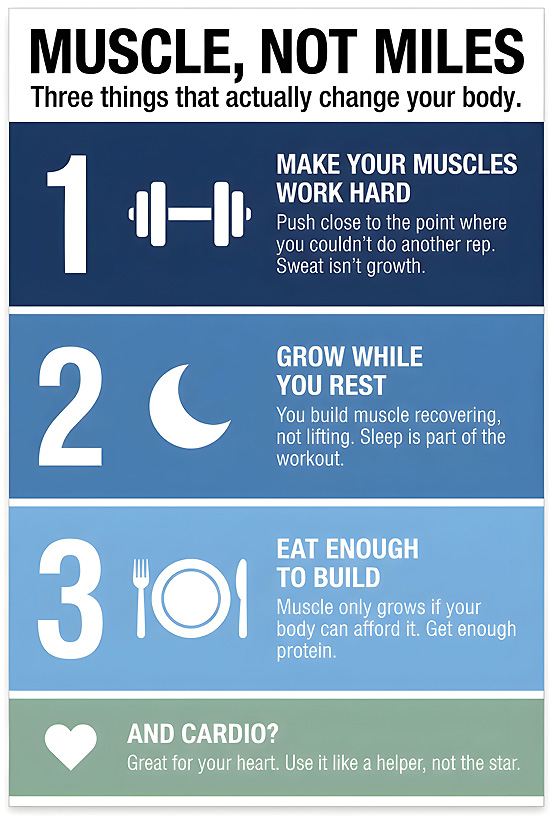
So where does cardio fit? Cardio isn't the enemy. Walking, biking, and easy jogging are great for your heart, and people rarely get in trouble by walking too much. The trouble starts only when cardio grows so big it eats into your recovery. Hours of hard running, piled on top of heavy leg days, can start competing with your muscle instead of helping it, and that hits harder as we get older. It's the amount, type, and timing that matter, not cardio itself. Use it like a helper, not the star, on days away from your hardest lifting.
One last note. You can lose fat, gain muscle, and look better while the scale barely moves, because muscle takes up less space than fat. People who quit because "the scale won't move" often quit right before it shows. So don't trust the scale alone. How do your clothes fit? What does a tape measure show? Are your lifts going up? If your waist is shrinking and your lifts are climbing, your plan is working.
Here's the simple version. Build first, then trim. Work your muscles hard and add a little more over time. Rest and sleep. Eat enough, especially protein. Use cardio like medicine, enough to help your heart, not so much it wears you out.
Do that, and the payoff shows up months later. Better posture, stronger joints, and a tighter waist. Isn't that what you're after?
Reference Links:
Concurrent Training: A Meta-Analysis Examining Interference of Aerobic and Resistance Exercises
Jacob M. Wilson, Pedro J. Marin, Matthew R. Rhea, Stephanie M.C. Wilson, Jeremy P. Loenneke and Jody C. Anderson
Journal of Strength and Conditioning Research, Published 26(8):p 2293-2307, August 2012
Click Here for the Study: https://doi.org/10.1519/JSC.0b013e31823a3e2d
A systematic review, meta-analysis and meta-regression of the effect of protein supplementation on resistance training-induced gains in muscle mass and strength in healthy adults
Robert W Morton, Kevin T Murphy, Sean R McKellar, Brad J Schoenfeld, Menno Henselmans, Eric Helms, Alan A Aragon, Michaela C Devries, Laura Banfield, James W Krieger and Stuart M Phillips
British Journal of Sports Medicine, Published July 11, 2017
Click Here for the Study: https://doi.org/10.1136/bjsports-2017-097608
Protein supplementation augments the adaptive response of skeletal muscle to resistance-type exercise training: a meta-analysis
Cermak Naomi M, Res Peter T, de Groot Lisette CPGM, Saris Wim HM, van Loon Luc JC
The American Journal of Clinical Nutrition, Published Online 7 November 2012
Click Here for the Study: https://doi.org/10.3945/ajcn.112.037556
A systematic review of the separate and combined effects of energy restriction and exercise on fat-free mass in middle-aged and older adults: implications for sarcopenic obesity
Eileen M Weinheimer, Laura P Sands, Wayne W Campbell
Nutrition Reviews, Published 1 July 2010, Pages 375–388
Click Here for the Study: https://doi.org/10.1111/j.1753-4887.2010.00298.x
Strength and Hypertrophy Adaptations Between Low- vs. High-Load Resistance Training: A Systematic Review and Meta-analysis
Brad J. Schoenfeld, Jozo Grgic, Dan Ogborn and James W. Krieger
Journal of Strength and Conditioning Research, Published 31(12):p 3508-3523, December 2017
Click Here for the Study: https://doi.org/10.1519/JSC.0000000000002200
Call for a FREE Consultation (305) 296-3434
CAUTION: Check with your doctor before
beginning any diet or exercise program.
7/30/2026


