


Flying Smart: How to Protect Your Health on Long Flights
That cross-country flight from New York to Los Angeles might only take 5.5 hours, but your body pays a price that goes far beyond cramped legs and stale airline food. After decades of research, scientists have pinpointed the real dangers and figured out exactly what you can do about them.
Blood Clots: The Biggest Risk
Let’s start with the scariest threat: deep vein thrombosis, or DVT. These blood clots can kill you if they travel to your lungs.
Recent studies show that among low to intermediate-risk travelers, about 0.5% (or 5 out of 1,000) develop asymptomatic blood clots detected by screening after flights longer than 8 hours. However, in high-risk groups with multiple risk factors, this can jump to up to 10%.
A review found that the risk of clotting increases by about 26% for every additional two hours of flight after four hours, especially for those with underlying risk factors. The risk is highest for flights longer than eight hours, especially if you’ve had recent surgery, have cancer, are older, or use estrogen-based medications.
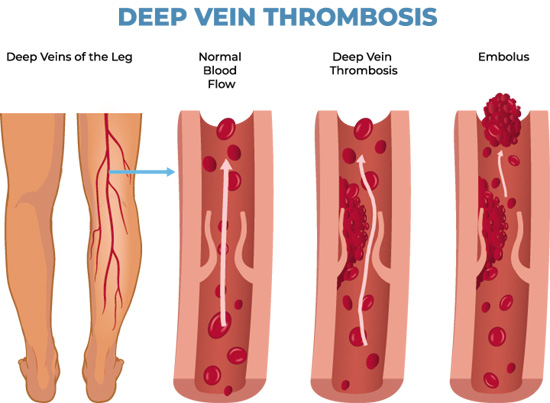
Only about 2 out of 10,000 people develop serious, symptomatic blood clots that cause noticeable problems on long flights, and most cases occur in passengers with risk factors. But if you fly frequently or over four hours regularly, these effects add up.
The solution that works: Compression stockings. A review of nine clinical trials involving 2,600 passengers proved their effectiveness. Without stockings, 22 out of 1,000 passengers developed clots. With stockings? Only 2 out of 1,000.
Buy knee-high compression stockings with 15-30 mmHg pressure (that’s how tight they squeeze, you’ll find this number on the package). Put them on at least two hours before your flight.
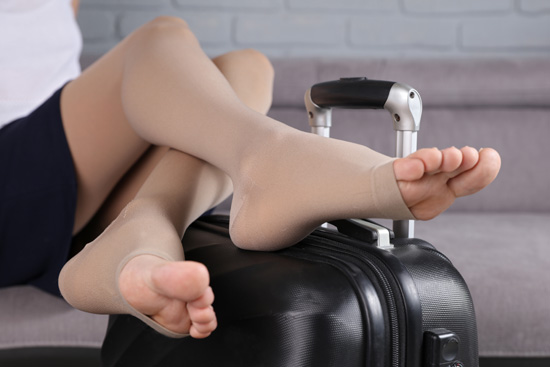
Can’t wear stockings? Do calf exercises from your seat. Research shows simple ankle circles and heel raises help maintain blood flow, though compression stockings remain the most proven prevention method. Get up and walk every hour if possible.
Dehydration: Worse Than the Sahara
Airplane cabins maintain about 10-20% humidity, with newer aircraft like the Boeing 787 running closer to 15-20%. The Sahara Desert has 25%. You’re flying through conditions drier than one of Earth’s most inhospitable environments.
Clinical research shows that dry cabin air causes you to lose more water through your breath and skin. Add in drinking less water than usual, plus the dehydrating effects of coffee or alcohol, and you can become seriously dehydrated. When you’re dehydrated, your blood gets thicker and flows more slowly, making blood clots more likely to form.
What works: A study found that electrolyte beverages worked better than water alone, increasing plasma volume and reducing blood thickness. Bring electrolyte powder or grab a sports drink at the airport.
Start hydrating the day before you fly. Skip alcohol and limit caffeine, both worsen dehydration. Bring an empty water bottle through security and fill it up. Pack moisturizer for your skin, saline spray for your nose, and eye drops if you wear contacts. That dry air will leave your skin feeling like parchment.
Hydration Hacks: How to Make Your Own Electrolyte Drinks
Altitude and Jet Lag
Airlines pressurize cabins to 6,000-8,000 feet above sea level. A study of 502 people found this drops blood oxygen by 4.4 percentage points after 3-9 hours, causing fatigue and headaches.
What helps: Practice slow, deep breathing during the flight to maximize oxygen intake. Avoid alcohol, which worsens altitude effects. If you have heart or lung problems, talk to your doctor before flying; you might need supplemental oxygen. Stay hydrated, since dehydration makes altitude sickness worse.
Jet lag happens when you cross time zones faster than your body can adjust. Your internal clock gets out of sync with local time, leaving you wide awake at 3 AM and exhausted at noon. Doctors found it scrambles your entire system, affecting hormones, digestion, and immune function.
Light therapy works: Flying east? Seek bright light in the morning. Flying west? Get light in the evening. Start shifting your schedule before travel. Go to bed one hour earlier each day for three days before eastward flights.
For melatonin users, take it at your destination’s nighttime, starting on travel day. This works best for eastward travel and large time shifts; westward flights often don’t benefit as much. For 7-8 hour time changes eastward, start 1-3 days early.
The Unglamorous Stuff
Gas expands at altitude, so bloating is normal. Eat light, avoid carbonated drinks, and move around. Your ears and sinuses hate pressure changes. Chew gum, yawn, and pack a decongestant if congested.
Bring This in Your Carry-on:
Compression stockings (15-30 mmHg)
Empty water bottle
Electrolyte packets
Moisturizer
Saline spray
Eye drops
Regular medications in carry-on
With the proper preparation, you can arrive feeling human instead of like a dehydrated zombie.
Reference Links:
Deep Venous Thrombosis and Pulmonary Embolism: Current Therapy
JASON WILBUR, MD, AND BRIAN SHIAN, MD
American Family Physician, Published March 1 2017
Click Here for the Study: https://www.aafp.org/pubs/afp/issues/2017/0301/p295.html
The association between air travel and deep vein thrombosis: Systematic review & meta-analysis
Yaser Adi, Sue Bayliss, Andrew Rouse & R S Taylor
BMC Cardiovascular Disorders, Published 19 May 2004
Click Here for the Study: https://bmccardiovascdisord.biomedcentral.com/articles/10.1186/1471-2261-4-7
Compression stockings for preventing deep vein thrombosis in airline passengers
Mike J Clarke, Cathryn Broderick, Sally Hopewell, Ed Juszczak, Anne Eisinga
Cochrane Database of Systematic reviews, Published 20 April 2021
Click Here for the Study: https://www.cochranelibrary.com/cdsr/doi/10.1002/14651858.CD004002.pub4/full
Fright of Long-Haul Flights: Focus on Travel-Associated Thrombosis
Emmanuel Papadakis , Eleni Gavriilaki , Nikolaos Kotsiou , Antonella Tufano , Benjamin Brenner
Thieme Seminars in Thrombosis and Hemostasis, Published 06 June 2017 - Cite this as: BMJ 2017;357:j2353
Click Here for the Study: https://www.thieme-connect.com/products/ejournals/abstract/10.1055/s-0045-1805038
Frequency and prevention of symptomless deep-vein thrombosis in long-haul flights: a randomised trial
John H Scurr, Prof Samuel J Machin, Sarah Bailey-King, Ian J Mackie, Sally McDonald, Philip D Coleridge Smith
The Lancet Journal, Published May 12, 2001
Click Here for the Study: https://www.thelancet.com/journals/lancet/article/PIIS0140-6736(00)04645-6/abstract
Up in the Air: Evidence of Dehydration Risk and Long-Haul Flight on Athletic Performance
Damir Zubac, Alex Buoite Stella and Shawnda A. Morrison
Hydration and Nutrition Considerations for Sports and Physical Activity, Published 25 August 2020
Click Here for the Study: https://www.mdpi.com/2072-6643/12/9/2574
Advancing Circadian Rhythms Before Eastward Flight: A Strategy to Prevent or Reduce Jet Lag
Charmane I. Eastman, Clifford J Gazda, Helen J. Burgess, Stephanie J. Crowley, Louis F. Fogg
Sleep Research Society, Published 01 January 2005
Click Here for the Study: https://academic.oup.com/sleep/article-abstract/28/1/33/2696715?redirectedFrom=fulltext
Jet Lag
Mary Choy, Rebecca L Salbu
Pharmacy and Therapeutics P&T, Published 2011 Apr;36(4):221-224, 231.
Click Here for the Study: https://pmc.ncbi.nlm.nih.gov/articles/PMC3086113/
Effect of Aircraft-Cabin Altitude on Passenger Discomfort
J. Michael Muhm, M.D., M.P.H., Paul B. Rock, D.O., Ph.D., Dianne L. McMullin, Ph.D., Stephen P. Jones, Ph.D., I.L. Lu, Ph.D., Kyle D. Eilers, David R. Space, and Aleksandra McMullen, M.S.
The NEW ENGLAND JOURNAL of MEDICINE, Published July 5, 2007
Click Here for the Study: https://www.nejm.org/doi/full/10.1056/NEJMoa062770
Prolonged flight exposure and its effects on sinonasal health among aircrew members
Mohammad H. Al-Bar, MD, MBBS.
Saudi Medical Journal, Published 2025; Vol. 46
Click Here for the Study: https://doi.org/10.15537/smj.2025.46.5.20241032
Effects of moderate alcohol consumption and hypobaric hypoxia: implications for passengers’ sleep, oxygen saturation and heart rate on long-haul flights
Rabea Antonia Trammer, Daniel Rooney, Sibylle Benderoth, Martin Wittkowski, Juergen Wenzel, Eva-Maria Elmenhorst
BMJ Journals Thorax, Published June 3, 2024
Click Here for the Study: https://thorax.bmj.com/content/79/10/970
Sleep at high altitude: A bibliometric study and visualization analysis from 1992 to 2022
Lixia Tan, Yong Li, Hongxiu Chen, Gongga Lanzi, Xiuying Hu
Heliyon ScienceDirect, Published Volume 10, Issue 1, 15 January 2024, e23041
Click Here for the Study: https://www.sciencedirect.com/science/article/pii/S2405844023102490
Call for a FREE Consultation (305) 296-3434
CAUTION: Check with your doctor before
beginning any diet or exercise program.
8/23/2025


