


Ice Baths May Be Killing Your Muscle Gains
Scientists Discover Ice Baths Reduce Muscle Gains by over 50%
For years, athletes have sworn by the ritual: crush a brutal workout, then shock your body with an ice-cold plunge. The theory seemed bulletproof. The ice helps flush out inflammation, speeds recovery, and allows you to come back stronger the next day. But new research is throwing cold water on this hot fitness trend, revealing that ice baths might actually be working against the very goals most gym-goers are chasing.
The ice bath sales pitch was seductive in its simplicity. Cold water constricts blood vessels, supposedly squeezing waste products out of battered muscles like wringing a sponge. As you warm up afterward, fresh blood rushes back in, delivering nutrients and accelerating healing. It made perfect sense. There’s just one problem: it doesn’t actually work that way.
Over 20 years of research consistently show that cold water immersion performs no better than simple active recovery methods like easy walking or gentle stretching when it comes to reducing soreness or repairing muscle damage.
The real bombshell dropped in 2024. Researchers published a comprehensive analysis in the European Journal of Sport Science, combining data from eight studies that tracked people doing resistance training with and without ice baths over periods ranging from one to three months.
The results were stark. People who lifted weights WITHOUT ice baths saw solid muscle growth, with gains that scientists classify as small to moderate. But if you ADD an ice bath immediately after training? Those gains shrank dramatically, by somewhere between 40 and 60 percent.
Think about that for a moment. If you’re hitting the gym three times a week, progressively overloading your muscles, eating right, and sleeping well, an immediate post-workout ice bath could cut your progress in half.
The problem lies in how cold water interferes with your body’s muscle-building machinery. After a challenging workout, your muscles launch a complex repair-and-rebuild process that includes a carefully orchestrated inflammatory response. This isn’t the chronic, disease-causing inflammation doctors warn about. It’s acute, beneficial inflammation that signals your body to build back stronger.
Ice baths throw a wrench into this process. Cold exposure suppresses muscle protein synthesis, the cellular assembly line that constructs new muscle fibers. It reduces the activity of satellite cells, which act like construction workers repairing and expanding muscle tissue. The cold even dampens hormonal responses that drive adaptation.
In essence, ice baths treat the inflammation your body needs to grow as if it were the enemy. It’s like calling the fire department to put out your furnace.
This doesn’t mean ice baths are entirely worthless. Research since 2018 has revealed at least one genuine benefit for mental well-being. Cold exposure triggers the release of dopamine and norepinephrine. Those are brain chemicals that can improve mood and reduce stress for hours afterward.
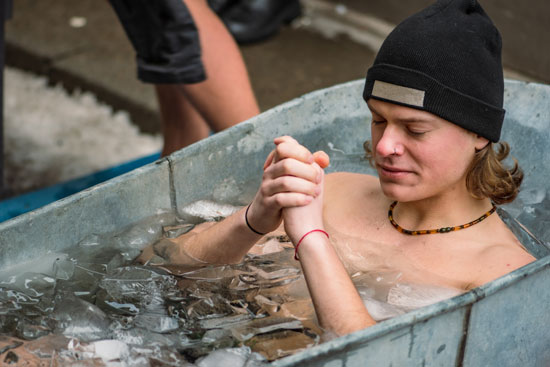
That effect helps explain why so many people become ice bath evangelists. They genuinely feel better after a plunge, even though their muscles aren’t actually recovering faster. The ritual can be psychologically powerful, creating a sense of accomplishment and mental toughness that carries over into other areas of life.
Before anyone rushes to fill a kiddie pool with ice, it’s worth acknowledging the risks. Sudden cold exposure spikes blood pressure and heart rate, which can be dangerous for people with heart disease or uncontrolled hypertension. The shock can trigger irregular heartbeats in some individuals, and prolonged exposure risks hypothermia.
Perhaps most surprisingly, some research shows cold exposure can INCREASE appetite, potentially undermining weight loss efforts.
For people who genuinely enjoy the mental boost or find meaning in the ritual, ice baths can be a helpful tool. But for everyone else, the evidence is overwhelming. Ice baths don’t help build muscle, don’t speed recovery from running, don’t aid weight loss, and carry real cardiovascular risks for people with heart conditions.
For the average person lifting weights to build muscle and strength, the message is clear: skip the immediate post-workout ice bath. The research shows you’re choosing to accept a significant penalty for no real benefit.
CAUTION: Before beginning any diet or exercise program, check with your doctor first. For a FREE consultation with a WeBeFit Trainer, call (305) 296-3434. Read all our articles online at WeBeFit.com and get updates by following us on Facebook.
Reference Links:
Throwing cold water on muscle growth: A systematic review with meta-analysis of the effects of postexercise cold water immersion on resistance training-induced hypertrophy
Alec Piñero, Ryan Burke, Francesca Augustin, Adam E. Mohan, Kareen DeJesus, Max Sapuppo, Max Weisenthal, Max Coleman, Patroklos Androulakis-Korakakis, Jozo Grgic, Paul A. Swinton, Brad J. Schoenfeld
European Journal of Sport Science, Published 05 February 2024 https://doi.org/10.1002/ejsc.12074
Click Here for the Study: https://onlinelibrary.wiley.com/doi/10.1002/ejsc.12074
Ice-water immersion and delayed-onset muscle soreness: a randomised controlled trial
Kylie Louise Sellwood, Peter Brukner, David Williams, Alastair Nicol, Rana Hinman
British Journal of Sports Medicine, Published Online First 29 January 2007
Click Here for the Study: https://bjsm.bmj.com/content/41/6/392
The effects of cold water immersion and active recovery on inflammation and cell stress responses in human skeletal muscle after resistance exercise
Jonathan M. Peake, Llion A. Roberts, Vandre C. Figueiredo, Ingrid Egner, Simone Krog, Sigve N. Aas, Katsuhiko Suzuki, James F. Markworth, Jeff S. Coombes, David Cameron-Smith, Truls Raastad
The Journal of Physiology, Published 04 October 2016
Click Here for the Study: https://doi.org/10.1113/JP272881
Call for a FREE Consultation (305) 296-3434
CAUTION: Check with your doctor before
beginning any diet or exercise program.
8/23/2025


