


Waist to Hip Ratio
Your Waist Knows Something Your Scale Doesn't
Step on a scale and you get one number. It tells you how much you weigh, but not where that weight sits on your body. That turns out to matter a lot.
In 2025, a group of 58 health experts from around the world took a hard look at Body Mass Index, or BMI. BMI can make a muscular person look like they're carrying too much fat. It can also miss someone with extra fat around the middle.
The experts recommended using BMI as a screening tool, then checking waist measurements or body fat to get a clearer picture. One simple option takes about a minute and needs only a tape measure. It's called your waist-to-hip ratio. It can't diagnose a health problem, but it can tell you when it's time to ask your doctor about your blood pressure, cholesterol and blood sugar.
Are You an Apple or a Pear?
Some people store extra fat on their hips, thighs and bottom. That's a "pear" shape. Others store it around the belly. That's an "apple" shape, and it carries more health risk.
Some belly fat sits just under your skin. Some sits deeper, wrapped around your liver and other organs. That deeper fat, called visceral fat, is closely tied to heart disease and type 2 diabetes. A tape measure can't tell the two kinds apart, but a bigger waist is a good clue.
Men tend to store more fat around the belly. Younger women more often store it on the hips and thighs, but many shift toward the belly around menopause.
How strong is the proof? In 2023, Canadian researchers studied almost 388,000 adults in the United Kingdom. With BMI, people at both the very low end and the high end had more risk of dying during the study. Waist-to-hip ratio was more straightforward. As the ratio went up, so did the risk, and that held steady across BMI categories. Genetic evidence from the same study suggests that fat around the middle may actually contribute to health problems.
The link was strongest in men, and almost everyone studied was White and British. Still, the researchers said it's time to focus less on how much people weigh and more on where they carry it.
Grab a Tape Measure
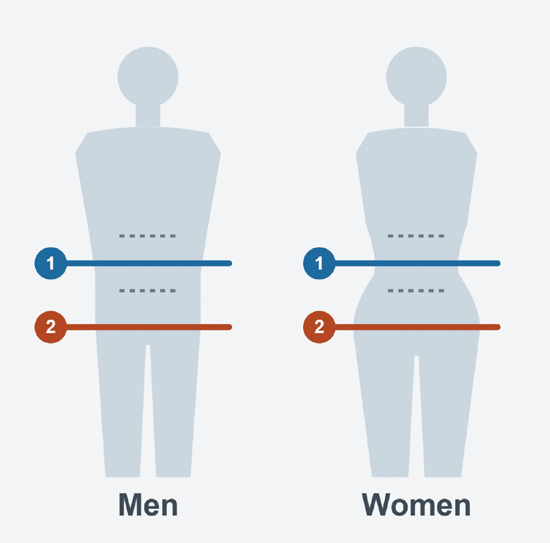
You need a tape measure that doesn't stretch. Men and women measure the same way. Stand tall with your feet together, arms loose at your sides, and measure against bare skin.
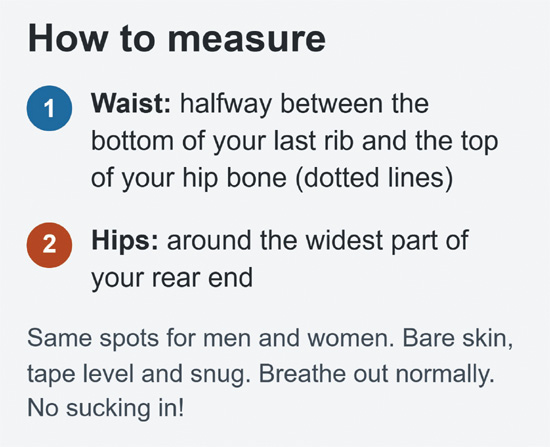
First, your waist. Find the bottom edge of your last rib and the top of your hip bone. Wrap the tape halfway between them, level all the way around and snug without pressing into your skin. Breathe out normally and read the number. No sucking in!
Next, your hips. Wrap the tape around the widest part of your rear end, keeping it level.

Now divide your waist by your hips. A 34-inch waist and 40-inch hips give you 0.85.
Click Here and our calculator will do the math for you.
Pro tip: have someone help, and use the same spots every time. Also track your waist on its own. If you build muscle in your hips and rear end, your ratio can improve even if your belly hasn't changed.
What's a Good Number?
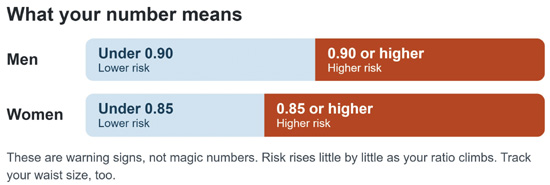
Two widely used warning signs are a waist-to-hip ratio of 0.90 or higher for men and 0.85 or higher for women. International health guidelines have used these cutoffs to flag people who may face a higher risk of heart disease and type 2 diabetes.
These aren't magic numbers. Risk rises little by little as your ratio goes up.
Your waist size tells a story on its own, too. For men, 37 inches is a commonly used warning point, with greater concern at 40. For women, those numbers are about 31.5 and 35 inches. People with Asian roots may face higher risk at smaller waists.
A low ratio usually means less belly fat compared with your hips, but it doesn't guarantee good health.
Why the Tape Beats the Scale
Here's the best part. Your waist can shrink even when the scale won't move.
A review of 117 studies found that both exercise and dieting reduced deep belly fat. Dieting usually led to more weight loss, but exercise tended to shrink more of the deep fat. The researchers estimated that exercise was linked to about a 6% drop in visceral fat even without weight loss.
The scale isn't wrong. It's just leaving out part of the story.
So measure your waist and hips today, work out your ratio, and write down all three numbers. Want a second check? Try the Body String Test. Then get moving and measure again in a month or two. Watch your waist most of all. It may be shrinking even when your weight isn't.
Reference Links:
Definition and diagnostic criteria of clinical obesity
Francesco Rubino, David E Cummings, Robert H Eckel, Ricardo V Cohen, John P H Wilding, Wendy A Brown, Fatima Cody Stanford, Rachel L Batterham, I Sadaf Farooqi, Nathalie J Farpour-Lambert, Carel W le Roux, Naveed Sattar, Louise A Baur, Katherine M Morrison, Anoop Misra, Takashi Kadowaki, Kwang Wei Tham, Priya Sumithran, W Timothy Garvey, John P Kirwan, José-Manuel Fernández-Real, Barbara E Corkey, Hermann Toplak, Alexander Kokkinos, Robert F Kushner, Francesco Branca, Jonathan Valabhji, Matthias Blüher, Stefan R Bornstein, Harvey J Grill, Eric Ravussin, Edward Gregg, Noor B Al Busaidi, Nasreen F Alfaris, Ebaa Al Ozairi, Lena M S Carlsson, Karine Clément, Jean-Pierre Després, John B Dixon, Gauden Galea, Lee M Kaplan, Blandine Laferrère, Martine Laville, Soo Lim, Jesús R Luna Fuentes, Vicki M Mooney, Joseph Nadglowski Jr, Agbo Urudinachi, Magdalena Olszanecka-Glinianowicz, An Pan, Francois Pattou, Philip R Schauer, Matthias H Tschöp, Maria T van der Merwe, Roberto Vettor, Geltrude Mingrone
Lancet Diabetes Endocrinol, Published 2025 Jan 14
Click Here for the Study: https://doi.org/10.1016/S2213-8587(24)00316-4
Surrogate Adiposity Markers and Mortality
Irfan Khan, Michael Chong, Ann Le, Pedrum Mohammadi-Shemirani, Robert Morton, Christina Brinza, Michel Kiflen, Sukrit Narula, Loubna Akhabir, Shihong Mao, Katherine Morrison, Marie Pigeyre, Guillaume Paré
JAMA Network Open, Published 2023 Sep 20
Click Here for the Study: https://pmc.ncbi.nlm.nih.gov/articles/PMC10512100/
Waist Circumference and Waist–Hip Ratio: Report of a WHO Expert Consultation
World Health Organization
World Health Organization, Published December 2008
Click Here for the Report: https://www.who.int/publications/i/item/9789241501491
A systematic review and meta-analysis on the effects of exercise training versus hypocaloric diet: distinct effects on body weight and visceral adipose tissue
R. J. H. M. Verheggen, M. F. H. Maessen, D. J. Green, A. R. M. M. Hermus, M. T. E. Hopman, D. H. T. Thijssen
Obesity Reviews - Etiology and Pathophysiology, Published 23 May 2016
Click Here for the Study: https://doi.org/10.1111/obr.12406
Call for a FREE Consultation (305) 296-3434
CAUTION: Check with your doctor before
beginning any diet or exercise program.
10/22/2006
Updated 10/23/2026


